|
*** *** *** *** *** *** *** *** ***
THROUGH CYPRUS *** *** *** *** *** *** *** *** *** [Kyrenia] [Famagusta] [Nicosia] [Lefke] [Limassol] [Paphos] [Larnaca]
PAPHOS / BAF
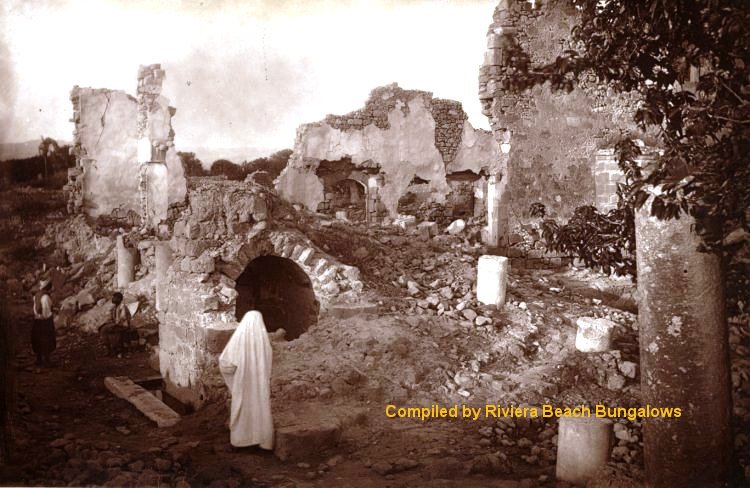
THE RUINS OF NEO PAPHOS
The ruins of Neo Paphos (Baf) bestrew the shore
below the modern town of Ktimu which stands about a mile inland;
and judging from the space now covered by debris, the ancient
city must have been one of the largest in Cyprus. About eight
miles to the eastward of it, a village called Kuklin marks the
site of Palæ Paphos, once famed for the worship of the wave-born
Aphrodite. At Neo Paphos, among the ruins of, and on the edge of
a cultivated field, is an ancient stone building which has been
partly excavated, and to this solid structure tradition awards
the honour of having formed a temple of the Cyprian goddess. Far
more probably, however, it is merely a relic of the older city
which was destroyed by an earthquake, and subsequently restored
by Augustus. *** *** *** *** *** *** *** *** ***
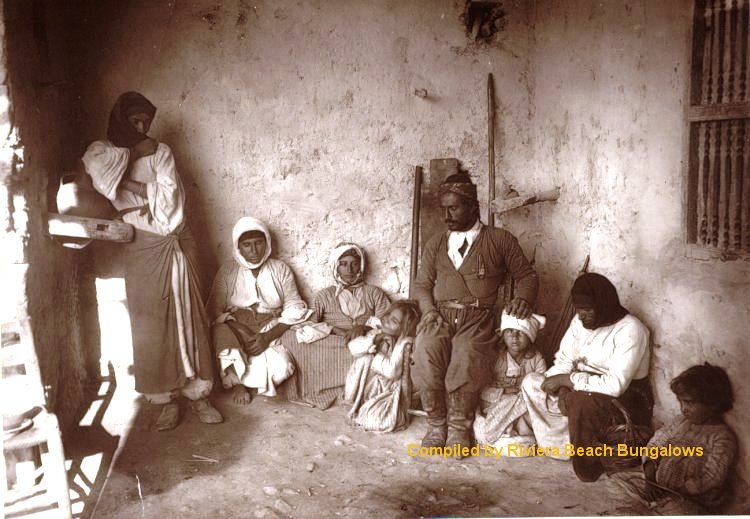
A VILLAGE GROUP, TRASHIBIOLA The village of Trashibiola stands on the summit of a ridge not far from the town of Paphos (Baf), and it was at this village that the group represented in the photograph now before us was taken, when they had assembled one evening in front of the principal house there—a house of which the giant Cypriote who sits in the centre of the picture was the fortunate owner. The objects of the gathering were twofold; firstly there were strangers to be welcomed, and, in the second place, a topic of absorbing interest had to be discussed. It seems that a vast herd of goats had wandered over the villagers’ fields and eaten up their produce. Probably, their herdsman having fallen asleep, the goats, weary of the dry herbage of the hill-sides, had strayed in search of more congenial pasturage; and as it never occurs to these simpleminded peasants, their proper course is to employ some of that brushwood which grows abundantly on the waste-lands, in so fencing in their produce as to offer no temptations to any half-famished herd of goats. It was suggested that the goats should be confiscated. They had eaten up part of the winter supplies, and they, in their turn, therefore, ought to be devoured. This view, however, was ultimately negatived, for it would have involved some points of law which would certainly have proved both parties in the wrong in any Mussulman court, whatever might happen under British rule. The villagers spoke hopefully of the new order of things, and to a man seemed ready to stand by their English masters, although in truth they knew little about them, and disquieting rumours were abroad that the Moslems were still in some way mixed up with the administration of affairs. Politics, after all, possess but feeble attractions for such people as these, unless some matter is stirring which seems likely to affect the immediate interests of their own little settlement, and all they ask is the liberty to till their fields unmolested, and to reap the just reward of their labours in peace. *** *** *** *** *** *** *** *** ***
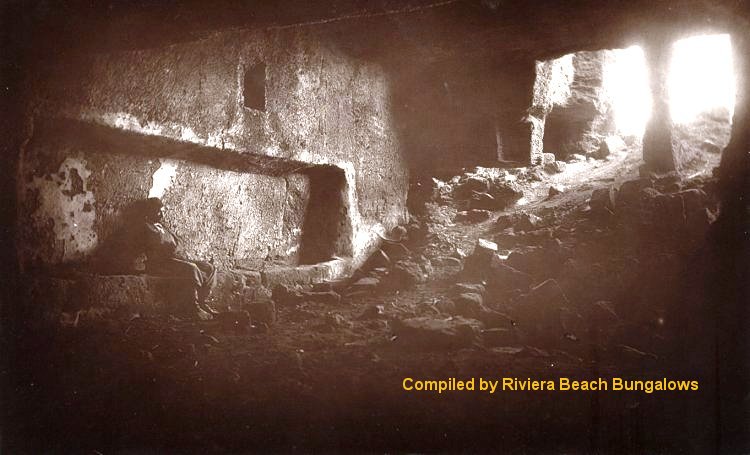
ROCK-CUT TOMBS, PALÆO-CASTRO, PLAIN OF PAPHOS These rock-cut tombs are found on an eminence which rises out of the plain within sight of the distant ruins of Neo Paphos (Baf), and about half—way between that place and Ktimu, the capital of the district. Many thousands of these ancient sepulchres, hewn out of the calcareous rock, are to be met with in this neighbourhood. Often they contain each several chambers which communicate one with the other, and in all there are niches in the walls, every niche affording space sufficient for a single body. These tombs have, invariably, been opened and despoiled of their contents, and are now partly filled up with rubbish. Cesnola says of them, “These graves are evidently pre-Roman; I had the rubbish removed from one of the largest, and found it to be an oblong building, with an atrium supported by three monolithic columns roughly hewn out of the limestone, and with a courtyard in front of it. The courtyard also contains several single graves. This must have been the family sepulchre of a great personage, and possibly one of the kings of Paphos.” The majority of the tombs, however, are less imposing, and closely resemble those shown on the face of the rock in the present photograph. Sepulchres of the same kind, hewn out of the solid rock, are also found at Curium, and, indeed, in many of the rocks that crop up over the plains or fringe the shore of the island. *** *** *** *** *** *** *** *** ***
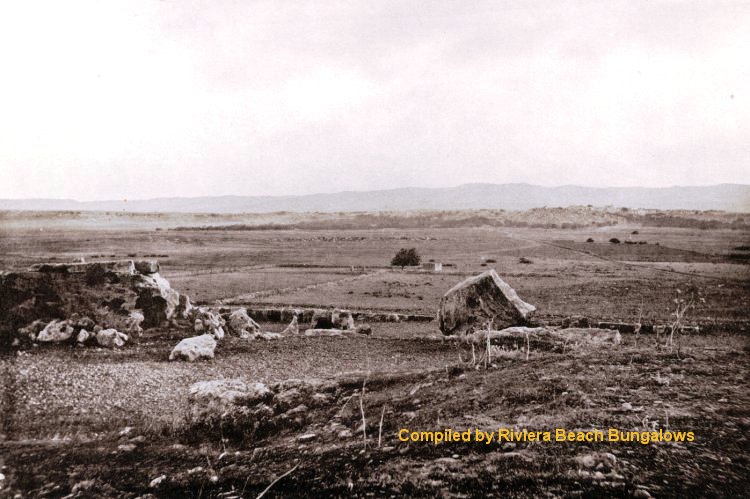
THE PLAIN OF PAPHOS In the middle-distance of this picture we see a portion of those limestone rocks which the ancients have honeycombed with their tombs, and Ktimu, the provincial capital, stands about half-a-mile further inland. The view shows us, not only the position of the town, but also the general appearance of a Cyprian plain, with its interspersed patches of fallow ground and cultivated fields. Neo Paphos is the port of Ktimu, a place of little commercial importance, containing a small mixed population of Turks and Greeks. The soil in this part of the province is exceedingly fertile, and might be turned to good account with a better system of tillage. Under the process at present in use, the fields are allowed to lie fallow for two or more years, during which time they are covered with a crop of thistles, grass, and weeds, so rank as to present a formidable obstacle to the farmer when he sets to work again to plough the land. The weeding is, for the most part, done by hand, some of the largest shrubs being set aside for fuel or house-thatching purposes, while the smaller growths are collected and burned on the field. The ash produced in this way, and the litter of herds set out to graze on fallow lands, are about the only manures used in Cyprus; and it is more by accident than design that these fertilizers find their way into the soil. As for the native plough, it is an implement of the most primitive type, but one which satisfies all the needs of Cyprian agriculture: the peasant yokes his team of lean oxen thereto, and cheerfully tickles the earth before sowing his grain, well-assured that, should the season be not unfavourable, he will gather a very fair crop of wheat or barley into his barns in due course. [Kyrenia] [Famagusta] [Nicosia] [Lefke] [Limassol] [Paphos] [Larnaca]
|