|
*** *** *** *** *** *** *** *** ***
THROUGH CYPRUS *** *** *** *** *** *** *** *** *** [Kyrenia] [Famagusta] [Nicosia] [Lefke] [Limassol] [Paphos] [Larnaca]
FAMAGOSTA / FAMAGUSTA / GAZI MAGOSA
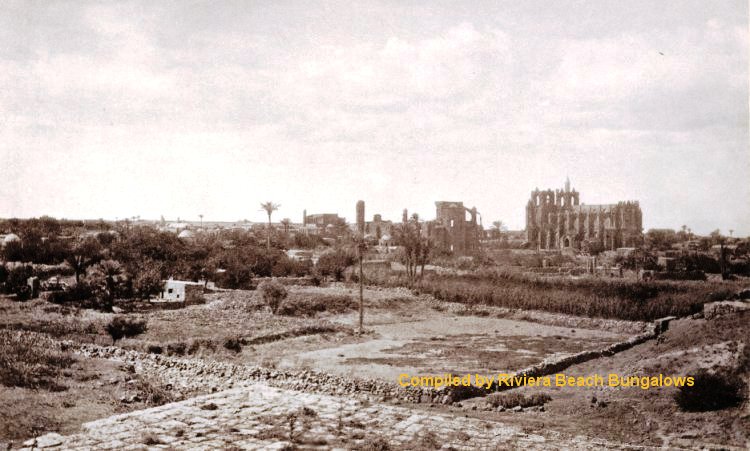
Famagosta (Famagusta / Magosa / Gazi Mağusa)
lies in the bight of a great bay, on the south-east of the
island, and not far from the ruins of ancient Salamis, a place
which, according to Cesnola, was used by the Christians as a
quarry when they built Famagosta, about eight hundred years ago.
But Famagosta boasts a history much more ancient even than this;
for it stands on the site of “Arsinoe,” and was renamed by
Augustus Fama Augusti (Ammnochostos). The city was overthrown by
the Turks in 1571, and was so left by the invaders that its
siege appears to have been an event of yesterday. It is a place
of ruins, a city of the dead, in which the traveller is
surprised to encounter a living tenant. It, however, affords
shelter to some six hundred Turks, whose wretched abodes are
found scattered among the ruins of old Gothic churches and
chapels. *** *** *** *** *** *** *** *** ***
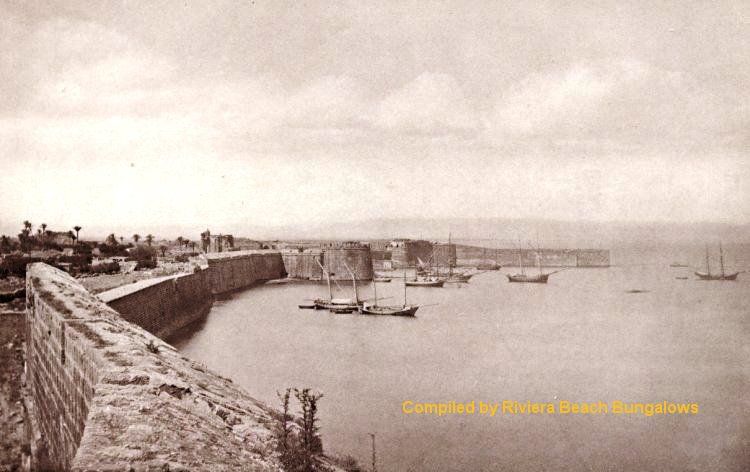
FAMAGOSTA HARBOUR The work of fortifying this stronghold has been carried out with a thoroughness which has defied the inroads of time, so that while the whole town has been laid waste, its outer wall still remains intact. Here and there a thistle or clump of grass has found roothold in some fissure in the massive battlements, but the finely—finished masonry presents few crevices in which even a breeze-blown seed may lodge. The once famous harbour, however, has been allowed to silt up, and now only affords anchorage for the class of vessels seen in the photograph. Beyond the port on the right there was once an ancient breakwater joined to a reef of rocks, so situated as probably to prove of great value in the construction of a commodious haven for men-of-war. These partly-submerged rocks are continued northwards by a spit of land about one mile in length, and covered by from two to four fathoms of water; but between the rocks and the land is a channel from a quarter to half a mile wide, and about seven fathoms deep. The bottom of the old basin is composed of sand and clay, the alluvial deposit brought down by the river Pedus, which, like the Nile, overflows its banks during the rainy season and fertilizes the plain. How far it may be possible to dredge out this harbour, and what depth of water may be obtained before reaching a solid substratum of rock, can only be determined by actual experiment. *** *** *** *** *** *** *** *** ***
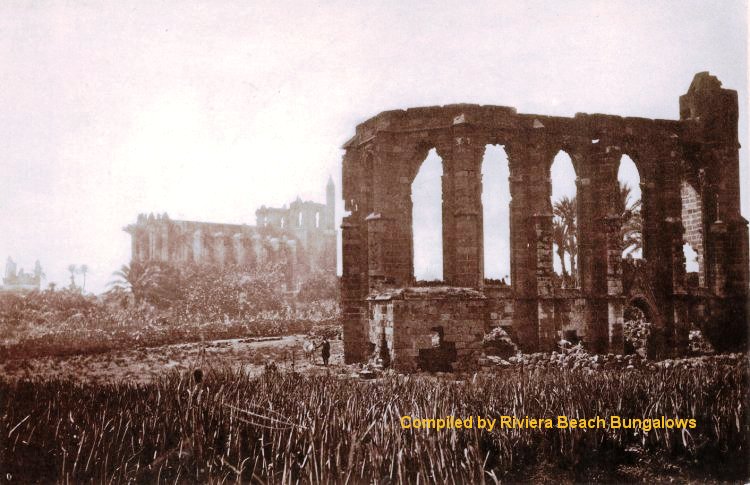
RUINS AT FAMAGOSTA
This view was taken at Famagosta from the inner side
of the moat and opposite the gateway at the north-eastern angle of
the wall. The prominent ruin here depicted was singled out as a good
example of the present condition of a multitude of churches that
were all gradually overthrown. On the inner walls of these shattered
edifices one may still discover traces of faded and disfigured
frescoes, and of elaborately-carved work in stone. The process of
undermining these noble walls appears to have been carried out
regardless of danger, and for no other purpose than to obtain blocks
of stone ready trimmed to make rubblework fences for wretched fields
or gardens. Many of the owners of these preserves reside in partly
mud-built hovels, although at but a very trifling expenditure of
labour they might have constructed themselves substantial stone
houses out of the remains of Christian churches and palaces. *** *** *** *** *** *** *** *** ***
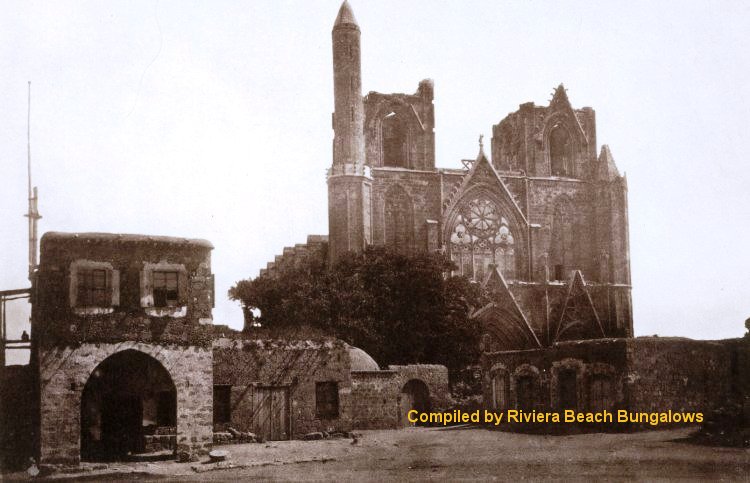
THE FRONT OF ST. KATHERINE'S CHURCH
The fine proportions of this noble specimen of Gothic
architecture are still preserved, and if the masonry has been sadly
mutilated and has now lost much of its ornament, enough yet remains
to show what the edifice must have been during the period of the
Lusignans and Venetians. The central window with its
richly-sculptured divisions is in good preservation, although many
of the spaces have been blocked up and coated over with whitewash.
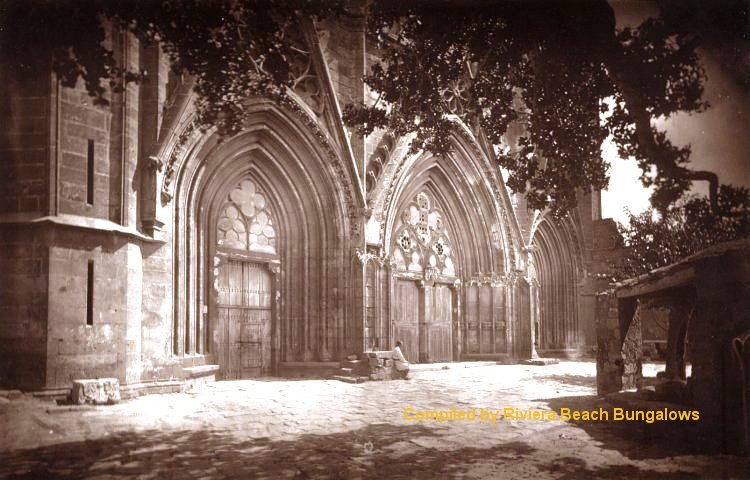
*** *** *** *** *** *** *** *** ***
This approach appears to have been once paved with marble in a manner worthy of the beautiful triple entrance to the ancient church. The lofty interior, like that of St. Sophia at Nicosia, has had to undergo much spurious alteration and spoliation ere Moslem tastes fitted it for the purposes of a Mosque. Pieces of rugs and matting now bestrew the floor, and Mussulmans worship above tombs where Knights, Crusaders, and Venetian nobles rested. On one of the marble slabs, bearing the date MDXXX., I observed a shield with a rampant lion, and an inscription beneath which might still be made out. There are many other mortuary slabs engraved with the names of Venetian nobles, “whose bones”, says Cesnola, “were exhumed and thrown into the sea by order of the fanatical and ferocious Mustapha Pasha, the day after he captured the city”. The same authority invests one of the towers, Torre del Moro, on the battlements overlooking the sea, with special interest by recalling the tradition which points out this tower as at one time the head-quarters of Christofero Moro, Lord-Lieutenant of Cyprus in the time of the Venetians, and the Othello of Shakespere. This incident happened during the years 1506 and 1508, so that the noble whose tomb carries the date 1530 would probably be alive when the Moor of Venice was ruler of the island. *** *** *** *** *** *** *** *** ***
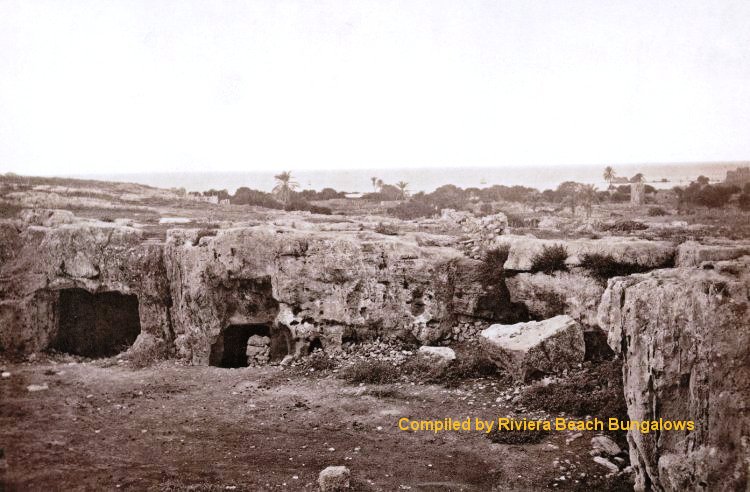
The rock-cut
tombs of Famagosta so closely resemble those at Paphos, already
described, as to leave little doubt that they belong to the same
period. The sepulchre here shown is now half-filled up with
rubbish, and the entrance to it is through a porch supported by
two pillars cut out of the solid rock. The interior is nearly
square, and in the sides and back wall are recesses designed for
the stowage of bodies; while above these again are sundry small
shallow niches. The walls appear to have been at one time
plastered over with some sort of durable cement. An adjoining
tomb, which seems to have been opened at a much later date, is
in excellent preservation. In this, besides recesses in the
walls before referred to, the apartment contains a sarcophagus,
and, altogether, has been so carefully finished as to suggest
the interior of a small chapel with a sacred font rather than a
mortuary. *** *** *** *** *** *** *** *** ***
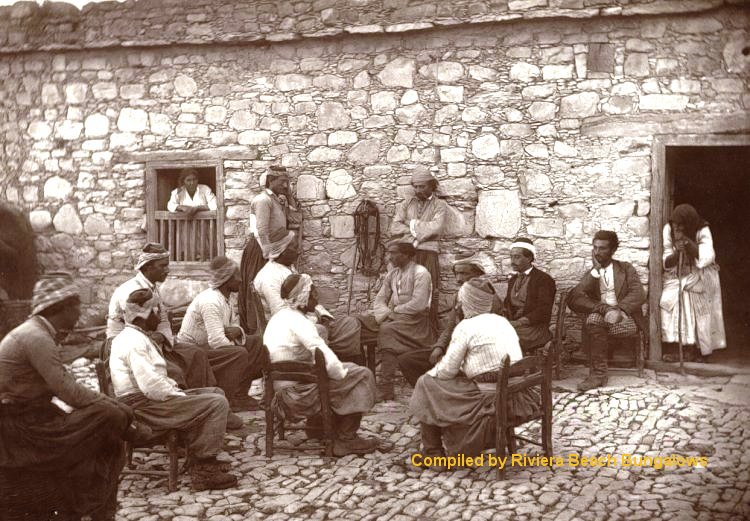
Avgoru is a
small village half-way between Larnaca and Famagosta, and about
five miles inland. It is built on stony ground, and the people
there support themselves by cultivating small patches of the
alluvial soil found in the hollows of the rocks. The place
stands on the outer edge of the plain of Mesorea, and is set
down by Gaudry as barren land. Grain and cotton, however, as
well as fruits, are grown there in sufficient quantities to
supply the small community with the necessaries of existence;
their cotton being spun, dyed, and woven by the villagers
themselves into strong fabrics for domestic use. Many of the
articles so produced are as remarkable for the tasteful patterns
they display as for their weight and durability. Among them we
find closely-woven table-covers, towels, and bed-sheetings, as
well as snow-white coverlets, fringed and wrought in open work
of most elegant design. The interiors of the dwellings at Avgoru
are poor, and their earthen floors are partly taken up in the
storage of produce; nevertheless, their occupants are
respectably clothed, and seem to turn their labour to good
account, for there is an absence of that squalor and misery
which we meet with among the poor in more highly-civilized
communities. *** *** *** *** *** *** *** *** ***
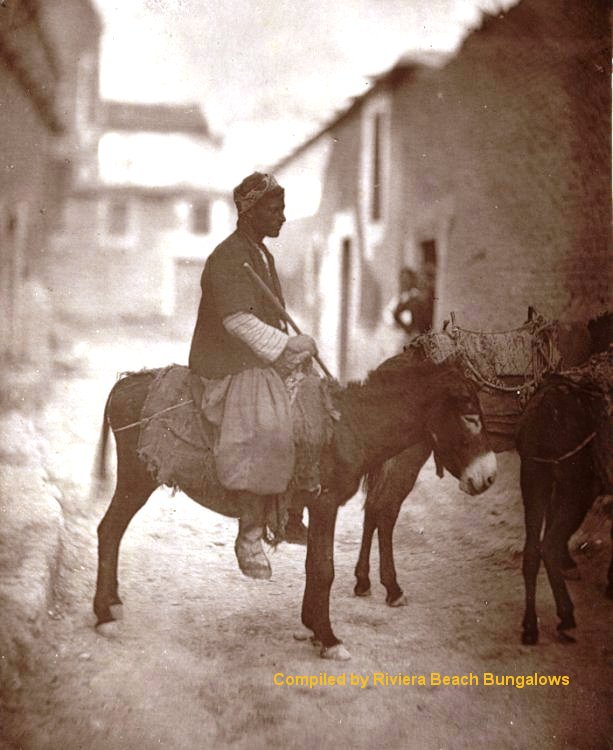
MULES AND DONKEYS Cyprian donkeys
and mules are most leisurely in their habits, and have a
wonderful aptitude for patiently awaiting their masters. They
will stand for hours at a time without stirring from the same
yard or two of shade, their heads turned toward the sun, so that
with the least possible exertion of their nether quarters they
keep constantly in shadow as the sun goes round. [Kyrenia] [Famagusta] [Nicosia] [Lefke] [Limassol] [Paphos] [Larnaca]
|