|
*** *** *** *** *** *** *** *** ***
THROUGH CYPRUS *** *** *** *** *** *** *** *** *** [Kyrenia] [Famagusta] [Nicosia] [Lefke] [Limassol] [Paphos] [Larnaca]
LARNACA / LARNAKA / ISKELE
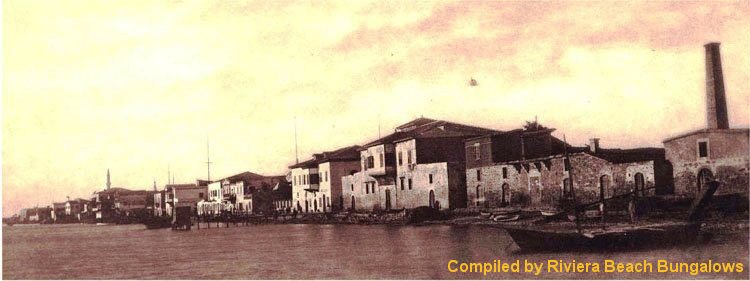
LARNACA MARINA LOOKING NORTH As we round Cape Citi and steam
direct for Larnaca (Larnaka / İskele) a scene
presents itself of peculiar Oriental beauty. The coast rises in bold
promontories, or retreats in russet plains to join the southern
chain of mountains, while looming in the distance, half lost in
vapoury haze. Mount Troodos (the Cyprian Olympus) is descried
crowning the range, whose lofty spurs shoot upwards in dark,
cloud-like masses against the horizon. With such a background to the
picture, and in contrast to it, the brilliant domes and minarets of
Larnaca rise into view at our feet. But the scene rapidly loses its
proportions, and when we have once cast anchor off the Marina the
town is disclosed in detail, deprived of the illusory charm of
distance. *** *** *** *** *** *** *** *** ***
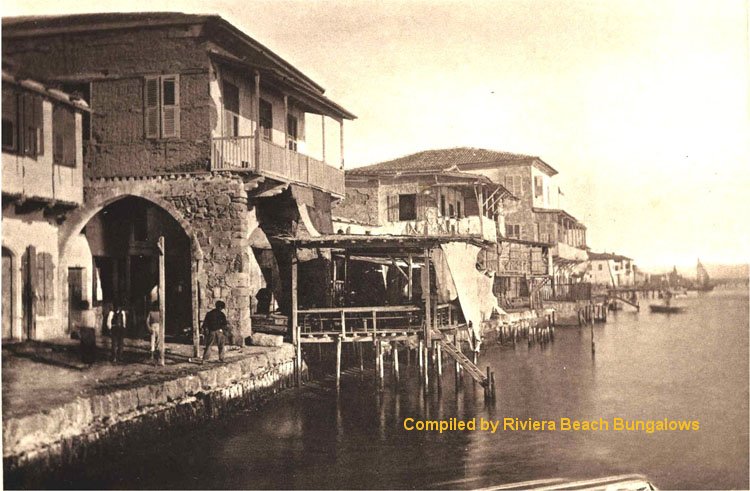
LARNACA MARINA LOOKING SOUTH At the northern extremity of the Marina are the buildings occupied by the Commissariat, the post office, and the residences of the British Commissioner and principal European merchants. Hereabouts, also, one or two retail stores have been opened, where may be seen an array of miscellaneous wares, which in some cases find eager purchasers, but more often constitute the un-remunerative types of the future wants of a rising settlement. Side by side with household necessaries one sees modern agricultural implements of marvellous mould, on which the natives gaze with bovine wonder. The roadway has been cleared, the sea-wall partially repaired, and lighted, for the first time, with a row of foreign lamps. About the centre of the Marina stands the first English hotel, which may be set down as a sample of the Greek houses of Larnaca. The principal porch conducts to a lofty apartment paved with blocks of coarse marble, and spanned in the centre by a massive Gothic arch, on which rest the rafters of the floor above. To the rear the ground-floor is taken up with domestic offices, above which arc the sleeping-rooms, overlooking an inner court and garden. In a town so seemingly barren as Larnaca these paved marble courts and their glimpses of green leaves are very precious. In most of them we find miniature orange groves, pomegranates, myrtles, roses, and oleanders. Fragments of sculptures from the ruins of Citium may be detected in the walls, while grouped around arc classic vases unearthed from ancient tombs, or broken statues rescued from the mounds that lie beyond the settlement. There are now a number of hotels in the Marina, as well as Greek boarding establishments, where the traveller may be comfortably lodged at a small cost. When the island was transferred to British rule speculators flocked to Larnaca, and companies were started in London for the immediate development of Cyprus. The place was to be raised from the dust, and become an Eastern El Dorado. The result was that rents for such houses as are pictured in the photograph rose from forty to three hundred or four hundred pounds a year. Soon, however, an exodus commenced, and only those immigrants remained who had come to Larnaca with the settled purpose of waiting for the tide of-gradual progress, which has indeed already set in. *** *** *** *** *** *** *** *** ***
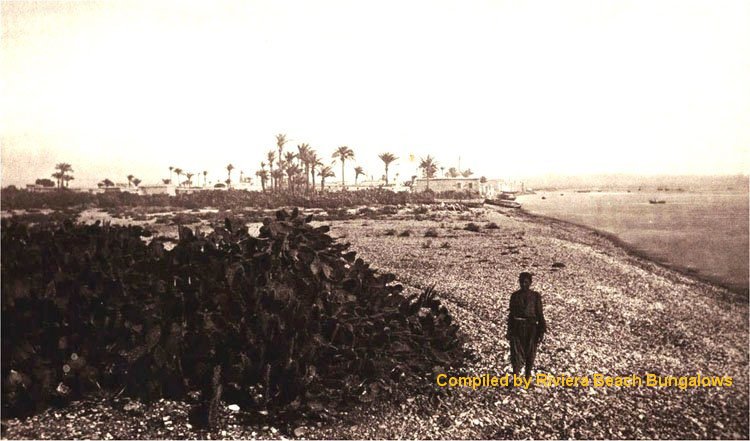
THE LARNACA SEA SHORE
LARNACA Marina is built on the shore, and the old town, or Larnaca
proper, situated about a mile inland. Together, the two divisions
Contain about 7000 inhabitants. The vacant space between the Marina
and old Larnaca marks the site of ancient Citium, a city celebrated
as the birthplace of Zeno the Stoic. On this spot one discovers
evidence to show that the sea has receded. “The ancient coast-line
is marked by a continuous, undulating line of rock”, while huge
stones, the remains of a pier or mole of olden times, are found
inland, not far from the French convent. *** *** *** *** *** *** *** *** ***
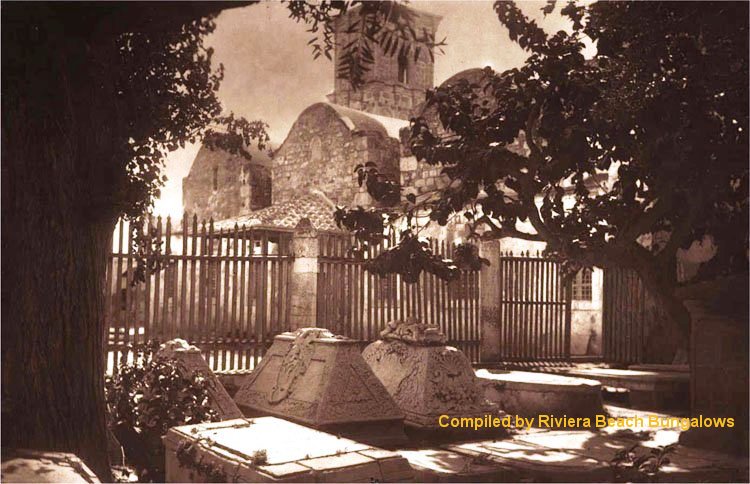
CHURCH OF ST. LAZARUS, LARNACA
The most remarkable church in the Marina is that dedicated to St.
Lazarus, and built some time in the tenth or eleventh centuries. *** *** *** *** *** *** *** *** ***
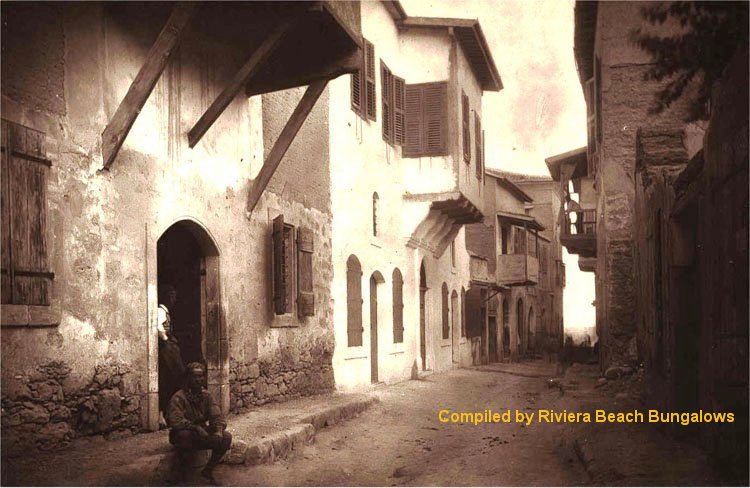
A STREET IN LARNACA
The streets of Larnaca are narrow, and, as a rule, devoid of
pavement, recalling in their general aspect the older quarters of
Alexandria, or Cairo. The houses, how ever, are more European in
style than those of Egypt, a peculiarity which they possibly owe to
the period of the Lusignan kings of Cyprus. In front., over the
central doorway, projects a verandah, closed in around, and so
fitted with Venetian shutters as to admit the breeze, but to exclude
the sunlight. *** *** *** *** *** *** *** *** ***
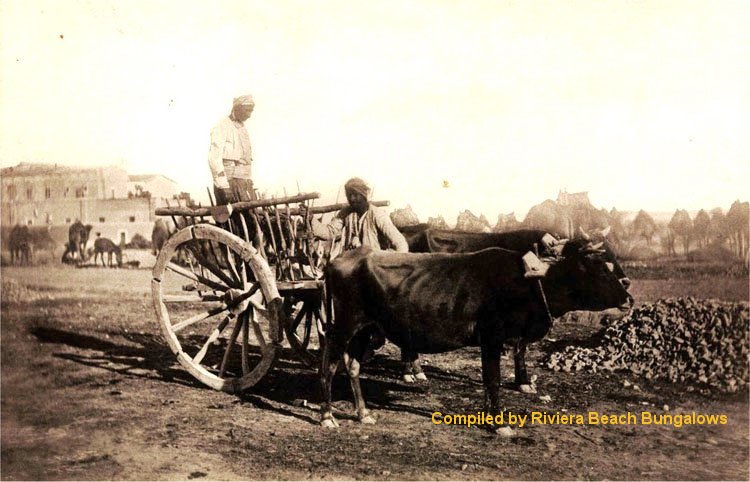
A NATIVE BULLOCK CART The bullock cart of Cyprus is a conveyance restricted in its use to a very limited area. It may be encountered on the dusty road to the capital, or to Famagosta, wending its way along to the rusty music of its wheels. We meet it also crossing the fertile plain of Mesorea (between the mountain ranges), labouring, produce-laden, down towards the coast, or hooded and transformed into a slow-paced jaunting car, conveying a family to some favourite resort. It is as picturesque in appearance as it is incomprehensible in construction. Why should its rude wheels weakly dip towards the axle, seeing that, were the wheels flat, greater strength would be obtained, as we1l as increased space in the carts? It may be that the diagonal strain of the spokes tends to keep the fellies together, and is a relic of a wooden age, when tires of iron were unknown. An intelligent wheelwright of Cyprus, when questioned on the subject, solved the mystery of the skeleton cone and short axle-trees, by stating that, to the best of his belief, wheels were always conical and axle-trees short. The bodies of these carts are constructed of a hard, fibrous wood, found in the island, of a kind admirably fitted to resist the strain and jolting on the rough roads traversed. The Cyprian ox is a finely-formed, clean-limbed animal, fleet of foot when not overburdened or underfed. It is used in ploughing and in treading out grain, and, as in India1 is held in reverence by the natives, who, as a rule, abstain from eating its flesh. *** *** *** *** *** *** *** *** ***
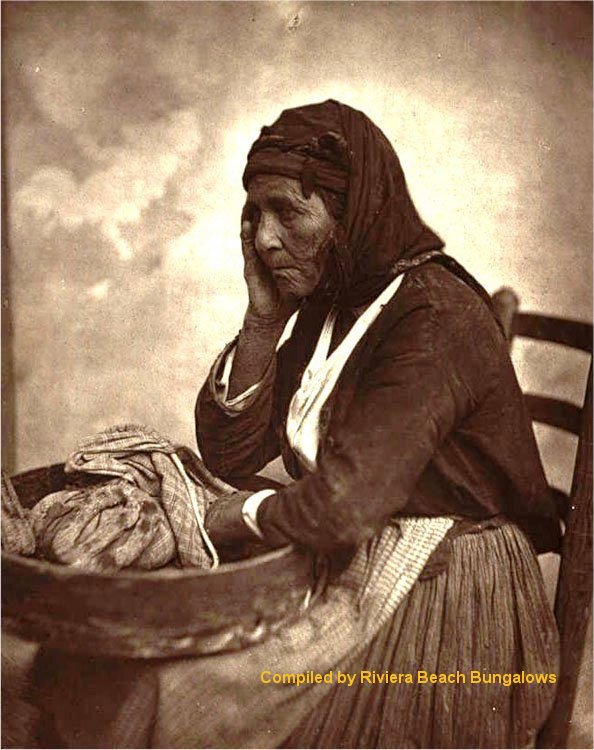
SELLING BREAD In the features of this old dame who earns her living by selling bread in Larnaca, there still linger traces of youthful comeliness. Her thin locks are silvered with age, and the years, as they dragged heavily along, have furrowed her brow. Yet her eye is clear and bright, and wears a look of calm contentment; it is the blue eye met with among Cypriotes of European origin. She might, indeed, pass for an old Scotch crone, or the decent owner of an apple-stall at the corner of some London street. With her modest earnings, probably amounting to no more in a week than a London huckster makes in a day, she is respectably clothed and housed; but it must be borne in mind that food and raiment are cheap in our newly-leased island, and that in the absence of palatial almshouse the poorer classes are constrained to adopt thrifty habits, and somehow contrive without difficulty to find shelter for themselves. *** *** *** *** *** *** *** *** ***
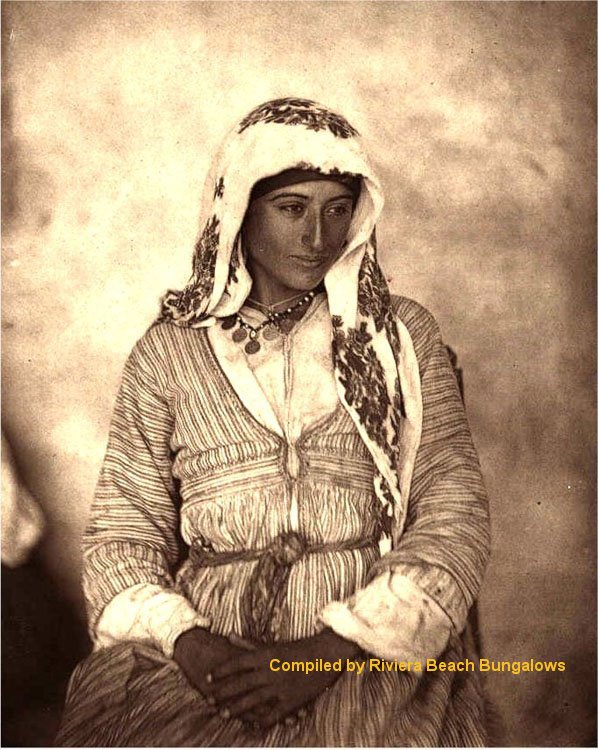
A CYPRIAN MAID The accompanying illustration may be taken as an ordinary type of the women of Cyprus. Martini, who travelled in the island, remarks that, but for their lustrous eyes, the women would be devoid of beauty. It may be added that they dress modestly, and many of them follow the Turkish fashion in keeping the greater portion of the face covered. Their complexions are generally fair, though bronzed by exposure, their features regular, and the colour of their hair varies from light brown to black. Some of them, notably those living in the mountainous districts of the island, are not unworthy descendants of the Cypriote maids of classic fame. The native beauty of the race is, however, seen at its best in the children, for the women, before they have reached maturity, are sent out to work in the fields, and are thus early trained to a life of toil. The result is that they lack much of that grace that comes of gentle nurture; they are, indeed, among the lower orders, little more than domestic servants, taking their full share of out-door labour as well as doing the drudgery of the household. Toil-worn as many of the women appear, there yet survives among them an aptitude for the arts that belong to a by-gone civilization. Thus, they are skilled in spinning and in weaving fabrics of cotton or silk, which they adorn with tasteful designs. Although their houses are rude, and seem to boast of nothing beyond the bare necessaries of existence, yet, stowed away in chests and ancient cupboards, they have stores of fine linen and holiday attire. *** *** *** *** *** *** *** *** ***
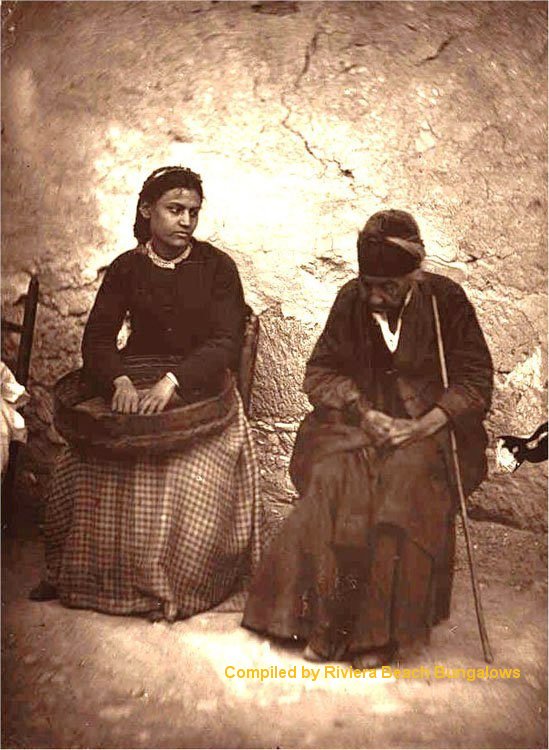
YOUTH AND OLD AGE Although it has been stated on high authority that in Cyprus aged parents are often treated harshly by their children, yet, in travelling through the island, one happily meets with examples of the tenderest filial affection. General Cesnola, describing a patriarchal custom which prevails among the peasants, tells us that when a man becomes too old to work in the fields, and has sons able to replace him, he voluntarily despoils himself sometimes of his whole fortune; and the gallant author goes on to say that in many instances this sacrifice is ill-requited, and the father is reduced to beggary. But such is not always the case. There are daughters in Cyprus, unblessed by parental endowments, who spend their days in sedentary toil in order to make life pleasant for their aged relations. The solicitude bestowed on the old folks in some, at least, of the Cyprian houses affords a pleasing sight. Their toilets are carefully attended to, their arm-chairs are set out in the shadiest nooks in the courtyard, and here we may see them taking their rest, or, staff in hand, wandering about at will. *** *** *** *** *** *** *** *** ***
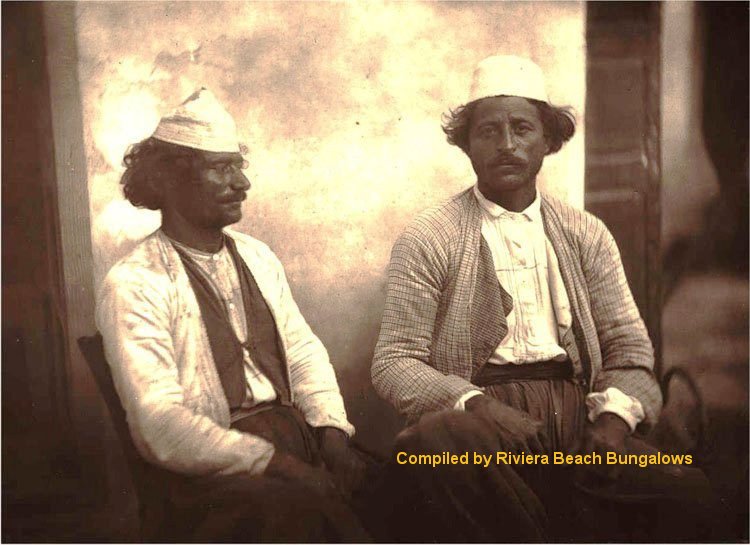
CYPRIOTE PEASANTS In the language of Lithgow, who
visited Cyprus more than two hundred years ago, “The people are
strong and nimble”. Again, he says of them, “They are civil,
courteous, and affable, and notwithstanding of their delicious and
delicate fare they are much subject to melancholy; of a robust
nature, and good warriors if they might carry arms”. It is evident
from the above summary, and from what may be gleaned from the works
of Pocock and other early travellers, that the modern Cypriote has
inherited the attributes of his ancestors. He is strong and nimble,
affable and courteous, and has a frame whose power and development
would adorn the ranks of the finest regiment. The two men
represented in this picture were selected at random from a throng of
peasants, such as may be seen any day in the streets of Larnaca. The
man on the right, standing erect in his native attire, as a powerful
and picturesque specimen of his race. He was tall enough for a
life-guardsman, and had the broad chest and muscular frame that
belong mainly to the mountaineers of the interior. He was a native
of an inland village, and had been down to Larnaca with produce. He
had a fine, open, expressive countenance, and nothing would have
afforded him greater pleasure than to have acted as the guide and
protector of any stranger who desired to visit his country home. [Kyrenia] [Famagusta] [Nicosia] [Lefke] [Limassol] [Paphos] [Larnaca]
|