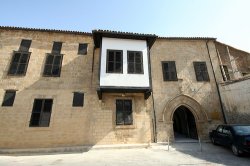
The mansion from the 15th century, which is
situated within the Lefkosa moat (ramparts), has survived to
this day and attracts attention by its Gothic arch entrance door
with its Lusignan era coat-of-arms as well as the Ottoman era
addition of a "kosk" and decorated wooden ceilings.
The mansion which has a typical inner courtyard
characteristic was built from cut stone and is 2-storied with a
roof but the added-on "kosk" (kiosk style) was constructed from
lath and plaster. The upstairs wooden veranda is reached from
the ground floor round-stone pillared veranda by a particular
stone stairs. The remains of the stone arches (later on filled
in), on the east wall of the rectangularly planned inner
courtyards, gives the impression that the building had an
eastward extension or connection.
The mediaeval buildings researcher Camille Enlart
speaks about this mansion in his book "Gothic Art and
Renaissance in Cyprus". The Austrian Archduke Louis Salvator who
visited the island in 1873, in his book, "Lefkosia, The Capital
of Cyprus" writes that a Turkish family named "Kalorio Al
Efendi" was using this mansion.
In 1958, the mansion, which had been used by the
Russian Classen family as residence and a weaving workshop, had
been bequeathed by them to the Cyprus Government.
The mansion, which was emptied (by the local
authorities) in the 1980's, had, until then, been partitioned
and left for the use of refugees. After the Antiquities and
Museums Department's two years arduous restoration work, in
December 1997 the mansion will be handed over to the coming
generations for the revival of the local weaving craft and for
the use of social activities.
In the mansion, which has been furnished with
authentic furniture of the Lusignan and Ottoman periods, there
is also a room for giving service to the visitors. 
Lefkoşa (Nicosia)
|
Gazimagusa (Famagusta)
|
Girne (Kyrenia)
|
Güzelyurt|
Iskele / Karpaz