Once the most important city
in Cyprus, the ruins of Salamis are still impressive today.
Set across a site of 1km fringed by a golden sandy beach,
there is much to explore and inspire in these great Roman
ruins – a definite must-see for anyone visiting North
Cyprus.

Excavations have shown that Salamis was
founded as early as the 11th century BC, with the first
inhabitants settling here from Enkomi after the earthquake
of 1075 BC. Remains of a necropolis, harbour, as well as
coins minted in “Salamis” (as early as 6th century BC) have
been discovered, as the city had developed into a major
trading port. Together with Syria and Anatolia, Cyprus was
ruled by the Achamenid Persian Empire during this period,
which lasted until the march of Alexander the Great into
Asia Minor. Following the unexpected death of Alexander the
Great near Babylon in 323 BC, his generals divided the lands
of the Hellenistic Empire and Cyprus fell to the Egyptian
king of Ptolemy.
The remains we can see at Salamis today
date back to the Roman era, during which the city once again
became the main trading centre of Cyprus. This prosperous
period continued into the Roman era, but the development of
Salamis was often interrupted by earthquakes and tidal
waves, especially during the 1st and 4th centuries AD. The
Byzantine emperor Constantius II (337-361 AD) did try to
rebuild the newly-appointed capital city, renaming it
Constantia – but, by this time the harbour was already
silted up and more natural catastrophes combined with raids
by Arab pirates during the 7th century led to Salamis’
decline, with inhabitants moving to Arsinoe, which was later
to become Famagusta. However, you can see how significant
Salamis was during its heyday, as the Royal Tombs, the
Bronze Age village of Enkomi and St. Barnabas Monastery are
all situated very near by.
Gymnasium and Roman Baths
This large complex served as an exercising
ground and school and is surrounded by columns on all four
sides. During the reign of Augustus (31 BC - 14 AD) a stone
basin with the statue of the emperor occupied its centre.
Some of its columns, capitals and bases originally belonged
to the theatre and were brought here by the Byzantines after
the earthquakes of the 4th century. In one corner there were
latrines (3) for 44 people. Another set of latrines (11)
existed on the north side of the baths. Two swimming pools
(5) occupied the two ends of the eastern colonnade (4).
These were decorated with marble statues. The first part of
the baths consisted of two octagonal plunge pools or cold
rooms (6), between which was the central sweating room (7).
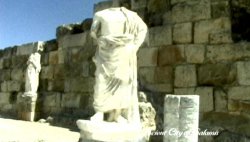
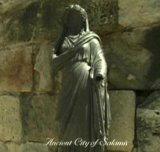
On the south wall of the baths you can see
a fresco piece surviving from the 3rd century AD
illustrating Hylas - the lover of Heracles who refuses the
water nymphs. In the southern hall you can see some of the
site’s finest mosaics, including one representing Leto's
children Apollo and Artemis killing Niobe's children with
arrows. The second mosaic features the legend of Leda and
the swan, whilst more mosaic fragments with floral and
geometric designs have survived in the north wall of the hot
room and in the northern sweat room.
Amphitheatre
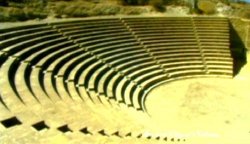
Dating back from the time of Augustus, this
impressive auditorium originally consisted of 50 rows of
seats (now there are 18 rows) and held over 15,000
spectators. Its orchestra bore an altar dedicated to
Dionysus and two bases dedicated to Marcus Aurelius
Commodus, and Caesar Constantius and Caesar Maximianus. The
performances would take place on the raised stage whose
background was decorated with statues. After it was
destroyed by earthquakes, the theatre was never rebuilt to
its former glory – but concerts still take place there
today.
Roman Villa
This two-storey villa consists of an apsidal
reception hall and a central inner courtyard with a columned
portico. The living quarters were grouped in the inner
courtyard but after the city was abandoned, this building
was used as an oil mill. The large stone was used to crush
olives; the mill stones and the straining device have
survived.
The Salamis Basilicas
As you walk along the main path of Salamis
towards the centre, you will encounter the Kambanopetra (Campana
Petra) basilica, which was originally home to the sarcophagi
of important church dignitaries. The basilica consists of a
column-fringed courtyard, a well for ablution, a nave with
aisles and a triple apse where the throne of the bishop and
the seats of the clergy were situated. Beyond the basilica
there was another group of buildings with a courtyard,
bathing facilities, a sweating room and one of the most
beautiful mosaics in Salamis consisting of a circular floor
of black and white triangles, or an opus sectile.
If you carry on walking to the far end of the site by the
sea, you will reach the Ayios Epiphanios basilica, built in
the 4th century. This was once the largest and most
significant basilicas in Cyprus and was built as the
metropolitan church of Salamis during the office of Bishop
Epiphanios (386-403 AD) whose tomb still lies encased in
marble in front of the southern apse. The edifice consisted
of a nave separated from its aisles by two rows of 14
columns with Corinthian capitals and ended with a
triple-arched semi-circular apse where there were seats for
the bishop and clergy. The rooms on each side of the apse
were used for dressing and storing liturgical apparatus.
Hypocaust remains in the baptistery show that the initiates
received their baptism in winter months with warm water. The
church was destroyed in the 7th century during the Arab
raids. The ruins at the back of the southern apse belong to
a smaller church built after the original one was destroyed.
The Agora (Stone Forum)
Once the meeting place and market of Salamis,
the Forum’s origins date back to the Hellenistic period
during which time it was lined with columned arcades which
protected the customers from heat in the summer and rain in
winter – but only one of the columns has survived to the
present day. Its courtyard contained temples dedicated to
gods related to commerce and was decorated with statues and
fountains.
Water Reservoir
Situated beside the forum was a vast
Byzantine cistern which could hold sufficient water for the
needs of 120,000 people. A system of earthen pipes and a
56km long aquaduct transported water to the city from Kyhrea.
This water system continued to function until the 7th
century. The walls and the remains of 36 square pillars of
the largest of the cisterns where this water was collected
have survived.
Temple of Zeus
Presiding over the Forum is the Temple of
Zeus, believed to the largest in the Roman Empire. During
excavations inscriptions in honour of Livia, Augustus'
consort, and the Olympian Zeus were discovered.