|



Nature & Wildlife
Orchids in North
Cyprus
The family Orchidaceae, thought to have originated from the
Liliaceae family, is one of the largest and most evolved plant
families in the entire plant kingdom. Orchids (Orchidaceae) comprise
the most diverse family of plants, with over 25,000 described
species in 400 to 800 genera worldwide. The Amazon is among the
world's richest sources of native orchids, from where thousands of
species are described and many more undoubtedly remain to be
discovered. Orchids are differ from other flowering plants because
they have: their stamens and pistils (male and female parts) fused
together in one structure known as a column three petals and three
petal-like sepals usually has one different petal that forms a lip
or labellum making the flower laterally symmetrical the pollen is
usually bound together in a few large masses known as pollinia their
flowers twists around during development known as resupination.
Ecology of Orchids
The ecology of orchids is a complex topic as the flowers themselves.
Orchids have a large habitat diversity and can be found almost
anywhere in the world, especially in tropical and warm temperate
regions. Many orchids live on other plants (epiphytic), on decayed
material (saphrophytic) or independent as usual plants (auto trophic).
Nearly all orchids are pollinated by insects notably bees and wasps,
but also butterflies, ants, flies and others. Moreover, almost every
orchid species is pollinated by just one or two kinds of insects.
Even though there are plentiful, many of them may go extinct if its
pollinator insect dies out.
North Cyprus Orchids
Because of their rarity and beauty, orchids hold a special
fascination for all naturalists. At North Cyprus, the orchid flora
consists of 32 confirmed species, subspecies and varieties and a
further three or five which presence needs verifying. Some species
will be familiar to botanists from north-western Europe, such as
pyramidal orchid and autumn lady's tresses, but there are also more
exotic species including violet limodore, tongue-flowered serapias,
naked man orchid and more. No doubt more observant botanists will
find these and other orchid species more frequently but we think it
s true to say that they are localised and hence always a delight
when stumbled upon.
 |
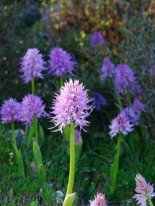
Orchis italica:
Perennial herbs with two ovoid or ellipsoid tubers. Leaves up to
10, bright green, rosulate, Stem erect up to 50 cm, with cailine
leaves. Infloresence dense and many flowered.
The flowers resemble a naked man. Pinkish-white with pink dots.
Species grows in grigue, in maqiue, or under Pine forest,
sometimes in damp grassy hillsides on calcerous soils from sea-leavel
to 1000m. Flowering period March-April. |
|
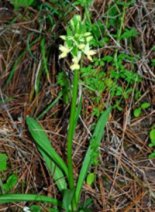
Dactylorhiza romana:
Perennial herbs with 2-3 tubers. Stem erect, up to 35cm. Leaves
up to 10, mostly rosulate, oblong to linear-lanceolate.
Infloresence few to many flowered, cylindirical, lax or dense.
Flowers spurred, bright yellow or pale yellow coloured and
unspotted. Species grows at dry rocky places in Pine forests,
often in association with Orchis morio ssp. Picta from 150 to
1000m. Flowering period March – May. |
|
Neotinea maculata:
Tuberous perennial herbs.
Stem up to 40 cm, pinkish-purple and glaucous. Leaves rosulate
and cauline, 2-6, spotted or unspotted. Infloresence dense, many
flowered. Flowers white, yellowish, pink or pinkish-purple.
Species grows in garig, under Pinus or Cupressus foreste,
usually on calcerous soils from 100 to 1000m. Flowering period
March – April. |
|
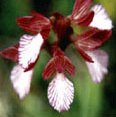
Orchis papilonacea:
Tuberous perennial herbs, with stem up to 50 cm. Leaves up to
10, mostly rosulate, unspotted. Infloresence up to 14 flowered,
lax or dense. Flowers dark pink, red to purple with darker
nerves and spots. Species grows in garigue or in dry grassy
places on calcerous soils near the sea-level. Flowering period
March-April. |
|
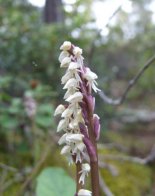
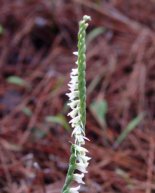
Spiranthes spiralis (L.) Chevall.:
Perennial herbs, roots tuberous and fleshy, stem up to 35 cm.
Leaves unspotted, fleshy, basal and cauline. Infloresence
spirally twisted, flowers numerous, white, scented.Species grows
on grassy banks and in sand dunes, .acier garigue 01 Pinus from
sea-level to 300 m. Flowering period September-November. |
|
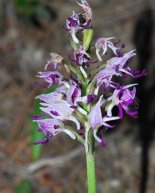
Orchis simia:
Perennial herbs with two ovoid or ellipsoid tubers. Stem erect
up to 45cm. Leaves 3-6, bright green, unspotted, rosulate and
sometimes with stem leaves. Insloresence dense and many
flowered. Flowers white with dark pink tips.Species grows in
garigue, and grassy places, on stony slopes, in Pine forsest, on
calcerous soils from 500 to 1000m. Flowersing period April –
May. |
|
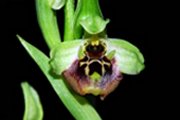
Ophrys bornmuelleri ssp. Bornmuelleri:
Distinguished from O. bornmuelleri ssp. bornmuelleri by its with
more compact and less elongated infloresence, up to 7 flowered.
Labellum brownish, hairy, with creamy yellow shoulders and
h-shape, below shoulders, without creamyyellow bordered. Species
grows at damp grassy places, in garigue, under Pine or Cypress,
on calcerous soils from 100 to 700 m. Flowering period
March-April. |
|
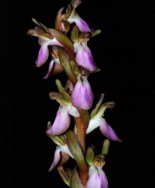
Orchis collina:
Tuberous perennial herbs. Stem up to 40 cm, rather fleshy often
red or purplish. Leaves rosulate and cauline, dark green.
Infloresence lax, up to 20 flowered. Flowers variable in colour
ranging from violet to creamy white. Species grows in garigue or
in sandy or stony places mostly on calcerous soils from
sea-level to 400 m. Flowering period February-March. |
|
|